Get a product-market-fit mentor who has been here before
Vetted GrowthMentor mentors who help early-stage founders prove the thing works before they scale it. Every mentor below wrote their own take on the work.
- 62,000+
- Sessions booked
- 750+
- Vetted mentors
- 4.8/5
- Avg session rating




Foti Panagiotakopoulos
5.0 · +59 more

Blaine
Founder · Permit Hound
"I don't want to walk through an uncleared minefield without someone who has walked it before."

Hamel Shah
Co-Founder · CarrotsAndCake
"GrowthMentor enables us to swiftly get a world-class expert to give us guidance on any marketing issue or…"

Lena Sesardic
Product Manager
"Knowing I can always book a call to help me clarify what I'm doing is the best feeling in the world."

Minh
Solo Founder · SEOmatic
"I like to set my own strategies and then get help from experts to improve on them and check if I'm on the…"

Nicola Rubino
Growth Marketing Consultant · nicorubino
"It gave me fast access to expert-level insights that I couldn't get from academic research or user surveys…"

Annie Chen
Head of Marketing · DOWN Dating App
"Sometimes I'm stuck at one step and all I need is someone who can share experiences of what they did when…"

Carlos Terol
Co-Founder · Bagmaya
"I enjoy having pretty much instant access to a pool of worldwide, expert mentors who are keen to share their…"

Luka Karsten Breitig
Co-Founder · The Happy Beavers
"Imagine a world where everything you read was written by a subject-matter expert."

Flora Bui
Co-Founder · Acie
"My favorite thing about GrowthMentor is how it allows me to expand my network globally in a very short time…"

Maria Ledentsova
Digital Marketing Manager · magier
"Whatever problem I have, there's a friendly and incredibly helpful mentor ready to help."

Kate Bojkov
Head of Growth · EmbedSocial
"How quick and easy I can find somebody who had my problem and is willing to talk with me and openly share…"

Supriya Agarwal
Co-founder · BiosectRx
"Being able to connect with any expert across the globe at the click of a button. No network or previous…"

Anastasia Rubleva
Head of Growth · Rapid Dev
"I love the ability to receive valuable feedback from mentors who have been in the industry for decades."

Andrew McBurney
CEO & Co-founder · Review Robin
"You should cut out 99% of the things that you're thinking about."
The mentors, in their own words.
60 mentors available
People saying they like your idea is a start. I want to know whether they use it, return and pay. At GrowthMentor, early signups exposed a trust problem we had to fix before bookings followed. I can help you examine where people stop, what they're telling you, and which assumption deserves a closer look.

I use in-depth customer research to help startups find the true pain points of their customers and align their products as indispensable solutions. I can help you plan your customer development project and define value propositions based on the data.

Product Market Fit is the degree to which a product satisfies a strong market demand and is foundational for growth. Many people have the misconception that they can “growth hack” their way to product/market fit (PMF). Trying to do this is generally very frustrating, expensive and unsustainable. Are you unsure if you have PMF? Do you need help getting to PMF? I have a proven framework to help you assess your PMF and use customer insights to unlock growth.

Daniel Johnson
GTM & Growth Operator | AI & B2B SaaS | Fractional CMO | £18M+ Revenue Driven
Understanding effective product-market fit is one of the most difficult and misunderstood tasks for early-stage businesses. Having run my own businesses and mentored hundreds through various accelerator programmes, I can assist in helping business validate product-market fit and identify validation techniques.

Zev Asch
Empathetic Listener. Strategic & Intuitive Creative Problem-Solver. Business Coach|Mentor
We all make this mistake at some point; falling in love with our technology or product, then going out to find customers. While all great product/service ideas were born out of individual frustration, detecting an unmet need or disrupting current practices - it doesn't guarantee success. There's an art and science to determining product market fit and it starts with my mantra of BE THE CUSTOMER - your ability to switch roles with your target user.

Daniil Kopilevych
B2B SaaS Sales Mentor and Cold Calling Partner. I help Pre-PMF Startups and Scaleups Book More Meetings with their ICPs.
Happy to share my learnings on how best measure your product's PMF. Will provide a few tips on running a PMF survey, tracking and segmenting responses, and acting on the takeaways.













.jpg)


















.png)
.png)
















%20-%20Aug2024.jpeg)
54 more product-market fit mentors
Create a free account to see everyone and book a call.
Create an accountHere's how it works.
Your request
""▍
Say what you're stuck on. We line up the right person.
A session
REC
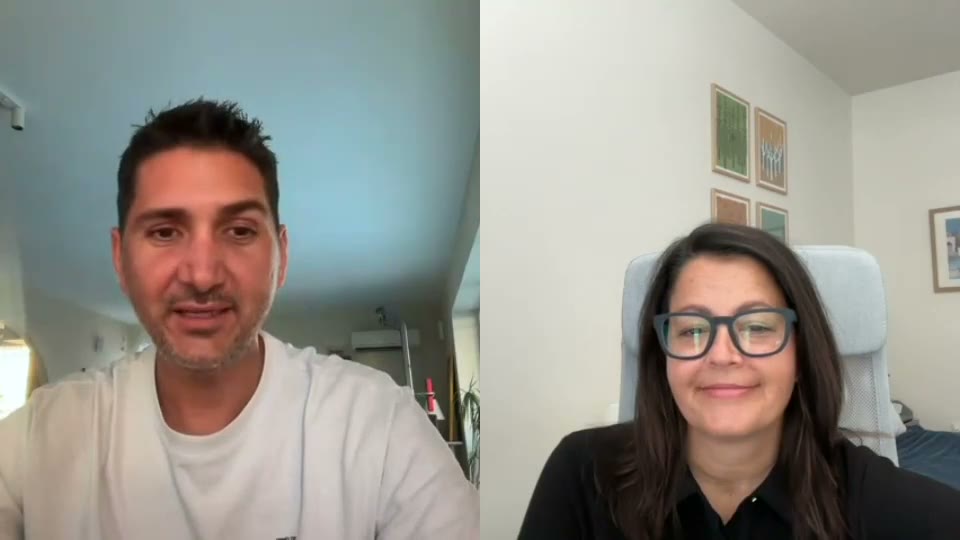
Live, one on one
30 min
Get the tactics from someone who's done it. Live, one on one.
After the call

Foti Panagiotakopoulos
Recording
You came in with
"Week-two churn, no clear why."
You left with
"Ask the ones who stayed, not the ones who left."
14:48 / 30:00
Jump to the moment
Keep the recording, summary, and takeaways. Yours to implement.
What a PMF mentor does
A product-market-fit mentor has already taken an early product from first signal to real demand, and lived through the stretch you are in now. You get a 1:1 call with someone who can look at what you have built, tell you whether the traction is real, and name the one thing to fix first.
Most calls do some version of five things:
- Turn the open question into a decision. "Is this working, should I pivot" becomes one concrete question with a clear next move and a reason behind it.
- Narrow the customer. The most common trap is building for everyone. A mentor helps you pick the one customer worth chasing and commit to them.
- Find where it breaks. Usage is happening but the funnel leaks somewhere. The fastest win is spotting which part to fix first, then fixing only that.
- Pick the channel. Instead of splitting effort across six ways to grow, you decide the one channel worth real focus, and what to drop.
- Fix the offer and price. Sometimes the product is fine and the way you present it or charge for it is the gap. A mentor helps you read which one it is.
The value is direction: whether this is working, and what to do next.
You also leave with a record. After each call, the takeaways are written down for you, ready to keep or skip:
 Ari BencuyaTraction sanity check
Watch whether week-four users come back, retention is the clearest read you have that the fit is real.
Pull your last ten paying users and find the one trait they share, that trait is the customer to chase.
KeepSkipOne person who pays, even a little, outweighs fifty who said they liked it.
KeepSkipName the single assumption the whole product rests on, then run the cheapest test that could break it.
KeepSkipDo you have PMF yet?
Most founders who book this call have a live product and some early signal. People are using it. A few are even paying. The open question is whether any of that adds up to product-market fit, or just adds up to motion.
A mentor helps you tell the difference between usage and demand:
- Usage is not the same as demand. people trying a free thing tells you far less than people coming back, paying, or pulling friends in.
- Early signal can be noise. a launch spike, a friendly network, or one loud user can look like traction and disappear next month.
- Retention is the clearest read. whether people stay after the novelty wears off is the clearest signal you have before you scale.
- One real buyer beats a survey. someone who pays, even a little, tells you more about demand than a hundred people who said they liked it.
Mentors start diagnosing before the call. A typical first exchange after you book:
 Harri Thomas
Who is it for?
"I have some traction but I cannot say who it is for" is one of the most common things founders bring to a call. The product works for somebody. You just cannot name them, so you cannot find more of them.
A mentor helps you define the customer worth committing to:
- Stop marketing to everyone. the most common reason nothing lands is that the message is aimed at no one in particular.
- Find the customer already pulling. the people who use it most or pay first usually point straight at the ICP you should commit to.
- Pick one of two audiences. serving two markets at once usually means serving neither well. A mentor helps you draw the line and choose.
- Say what it does in one line. once the customer is clear, the positioning gets clear, and the funnel you could not fix starts to make sense.
Launched to silence
You launched a few weeks ago and almost nobody showed up. The product is live, there are real users or downloads, and the revenue is near zero. This is the most common arrival on this page, and it is also the most disorienting.
A mentor who has been through a flat launch helps you read the silence:
- Get your first ten real users. they are usually an introduction or two away in your own network, not waiting at the end of a campaign.
- Tell signal from noise. a few engaged users who come back matter more than a launch-day spike that never returns.
- Find the first blocker. the gap is usually the audience, the problem, or the message, and the fix for each is completely different.
- Decide before you rebuild. rebuilding the whole product is the most expensive guess. A mentor helps you test the cheapest assumption first.
A flat launch is information, not a verdict. The point is to read it right before you act on it.
Almost every flat launch feels like rejection and is really under-reach. A mentor who has read the silence can tell you which before you act on it.
Should you pivot?
Sometimes the original model, market, or audience has to change. The hard part is deciding that from evidence instead of fear, and changing direction once instead of thrashing through five.
A mentor who has run a pivot helps you make the call cleanly:
- Decide from signal, not mood. if the people you talk to keep telling you the problem is minor, more features will not save it, and a pivot might.
- Separate the model from the idea. often the idea is fine and the business model or audience around it is what needs to move.
- Pressure-test both directions. the one you are tempted to jump to deserves the same hard questions you should have asked the first one.
- Change once, on purpose. a deliberate pivot built on one clear reason beats a series of half-pivots driven by a bad week.
A second opinion before you turn the ship is usually faster than turning it twice.
two decisions, in order
Separate the model from the idea
scrap the whole thing and start over
keep the idea, move the model or the audience around it
Change once, on purpose
a new direction every bad week
one deliberate pivot built on one clear reason
A pivot you only make once
You turn the ship on evidence instead of fear, and you do it a single time instead of thrashing through five half-turns.
The order matters: find what actually has to move before you move it.
Validate before you build
The most common structural trap for founders at this stage is building first and asking the market later. You ship, then you find out whether anyone wanted it. A mentor helps you reverse that order on the next thing you make.
Most of the work is learning to test demand cheaply before you commit code to it:
- Customer interviews. Ask what people did the last time they hit the problem, not whether they like your idea. A real workaround story is worth more than praise.
- Demand tests. A landing page, a waitlist, or a pre-sale can tell you whether the interest is real before you build the feature behind it.
- Feedback that bites. Getting users to tell you the truth is a skill. A mentor helps you set up feedback that changes your mind, not just flatters it.
- Pick the next thing. When ideas come faster than you can ship them, the win is naming the one assumption everything rests on and testing that one.
If you already built before validating, you are in good company, and it is recoverable. The move is the same: find the one assumption everything rests on, then design the cheapest test that could prove it wrong.
Keeping the customers you win
Some founders here are past the first MVP. They have paying customers. The new problem is that those customers leave, or do not pay enough, and the numbers will not hold long enough to scale.
A mentor who has fixed retention before scaling helps you find the real leak:
- Fix retention before you scale. pouring acquisition into a leaky product just spends money faster. The churn has to get solved first.
- Watch the unit economics. if it costs more to win a customer than they are worth, growth makes the problem bigger, not smaller.
- Find the expansion path. sometimes the fix is getting existing customers to pay more, not finding new ones who pay too little.
- Decide whether to move upmarket. a plateau after early sales is often a sign the ICP should shift, not that the product is finished.
Retention is the part of fit that does not show up on launch day and decides everything after it.
a retention read, x-rayed
The last three monthly cohorts lined up side by side1. The week each one falls off marked in red2. Ten churned users read back to back for the reason they name3. The line drawn in advance: fix that reason before a dollar goes to acquisition4.
The cohorts
Three months of signups side by side, so a drop reads as a pattern instead of a bad week.
The cliff
The week retention falls off. Most churn happens before a customer ever feels the value.
The reason
Ten churned customers in their own words. The same reason repeats faster than you expect.
The line
A rule set before you look, so you fix the leak instead of acquiring around it.
Every part points at why customers leave before you spend to win more. A mentor helps you find the leak the top-line number hides.
Pricing before you scale
Pricing is one of the hardest calls at this stage, and one of the most common reasons people book. The instinct is to treat price as a number to set later. More often it is a lever you should be using now to learn what people value.
A mentor who has priced an early product helps you with the questions that matter:
- How you present the price. often the model is fine and the way you communicate value around it is what is holding back conversion.
- What model fits the product. subscription, one-off, commission, or usage. The right structure depends on how customers get value, not on what is fashionable.
- Whether to show price at all. showing or hiding price on your site is a strategy decision, and a mentor can tell you which fits your buyer.
- Charging as a demand test. a small price someone pays beats any number of people who said they would, and it is one of the cleanest signals you get before you scale.
Get pricing roughly right early and the rest of the growth math gets a lot easier.
two moves, in order
Put a real price in front of real people
a number you plan to set once things settle
a small price ten users are asked to pay this week
Let what they pay tell you what they value
guessing what the product is worth
reading the one thing buyers will actually pay for
Price becomes a demand test
A number someone pays is the cleanest signal you get before you scale, worth more than any survey of people who said they would.
The order matters: charge first, then let the answer set the number.
When to book a call
You do not need a giant question to book. A single stuck decision is enough. The moments worth a call:
- You launched to silence. the product is live, almost nobody showed up, and you cannot tell whether that is the audience, the problem, or the message.
- You have traction you cannot explain. people are using it, but you cannot say who they are or how to find more of them.
- You are weighing a pivot. the original model is not working and you want someone to pressure-test the change before you make it.
- Customers are churning. early sales happened, then people left, and you need to know whether to fix retention, the offer, or the price.
- You are under runway pressure. the clock is loud, a board or investors want results, and you need one clear move more than ten options.
- You are about to spend on a channel. you are about to commit real budget and want a second opinion on whether it is the right bet first.
A focused 30 minutes with someone who has made the call before usually beats weeks of circling it alone.
What a mentor can help with
Product-market fit touches the whole business, and so does the network. You are not limited to one specialist. You can find someone who has done the specific thing you are stuck on:
- Idea validation. Customer interviews, demand tests, and reading early signal before you commit.
- ICP and positioning. Naming the one customer worth chasing and what your product does for them.
- Go-to-market strategy. Sequencing the first channels and the path from signal to repeatable growth.
- Retention and unit economics. Churn, LTV, expansion, and the math that has to hold before you scale.
- Pricing and monetization. Model, price presentation, and using price to learn what people value.
- Product management. Prioritizing what to build next when ideas outrun what you can ship.
- Sales and outreach. Getting your first paying customers and the early sales motion to repeat it.
- Fundraising and capital. When to chase capital, and how to talk to investors as a first-time founder.
Whether the stuck point is the ICP, the offer, or the next thing to build, there is a mentor who has solved that exact one.
You can also run it in reverse: post what you are stuck on as a help request, and mentors raise their hands to take it.



What people book product-market fit calls about
Rarely what they end up solving. The ask on the booking form is usually a symptom, and a mentor who has done this work recognizes the pattern underneath it. Three that come up again and again:
walked in as, walked out as
Walked in as
A traction problem
Is any of this real?
Walked out as
A retention read
Do they come back next month?
Walked in as
A pivot question
Do we change direction?
Walked out as
A signal question
Your users already answered.
Walked in as
A churn problem
Customers keep leaving.
Walked out as
A fit problem
They never hit the value.
Three calls, one mechanic. The problem that leaves the room is never the one that walked in.
Why GrowthMentor
Every mentor on GrowthMentor is vetted before they are accepted. Fewer than 5% of applicants get in. They are founders, operators, and advisors who do this work daily, not influencers selling a course.
Because the network is broad, you are not stuck with one channel specialist when your question spans the whole business. You can find someone who has taken an early product from signal to demand, tell them where you are stuck, then find a different person for the next decision.
Calls this month
Book the fourth call, or the fortieth. Nothing on this receipt changes.
People who were exactly where you are.
GrowthMentor enables us to swiftly get a world-class expert to give us guidance on any marketing issue or question in a matter of days.

Hamel Shah · Co-Founder
Read Hamel's storyKnowing I can always book a call to help me clarify what I'm doing is the best feeling in the world.

Lena Sesardic · Product Manager
Read Lena's storyI like to set my own strategies and then get help from experts to improve on them and check if I'm on the right track.

Minh · Solo Founder
Read Minh's storyIt gave me fast access to expert-level insights that I couldn't get from academic research or user surveys alone.

Nicola Rubino · Growth Marketing Consultant
Read Nicola's storySometimes I'm stuck at one step and all I need is someone who can share experiences of what they did when they were in my situation.

Annie Chen · Head of Marketing
Read Annie's storyI enjoy having pretty much instant access to a pool of worldwide, expert mentors who are keen to share their expertise and help others.

Carlos Terol · Co-Founder
Read Carlos's storyAsk ChatGPT
Don’t take our word for it.
Ask ChatGPT what it really knows about product-market fit mentors and GrowthMentor, then decide for yourself.
Before you join
What people ask before their first call.
Look past usage to demand. People trying a free product tells you less than people coming back, paying, or bringing others in. Retention is the clearest signal you have before you scale. A mentor who has crossed this gap can give you a straight read on whether your early traction is real or just motion.
A flat launch is information, not a verdict. The gap is usually the audience, the problem, or the message, and the fix for each is different. Start by getting your first ten real users, who are often an introduction or two away in your network, and read whether they come back. A mentor can help you find the one blocker before you rebuild anything.
Start from the people already pulling hardest: who uses it most, who paid first, who keeps coming back. They usually point straight at the customer worth committing to. The most common mistake is marketing to everyone, so a mentor helps you pick one audience and let your positioning follow from that choice.
Almost always niche down first. Serving everyone usually means nothing lands on anyone, and serving two audiences at once means serving neither well. Pick the one customer worth winning, prove it works there, then widen. A mentor can help you choose the narrow target with the most signal behind it.
It depends on where your early signal is strongest, how people get value, and how you can reach them. A mentor who has built in both can give you a straight read on which one fits your product and stage, and which to stop splitting effort across.
Reverse the order: test demand before you commit code. Customer interviews, a landing page, a waitlist, or a small pre-sale can all tell you whether the interest is real first. Name the one assumption everything rests on, then design the cheapest test that could prove it wrong. A mentor can help you set that test up.
Ask what people did the last time they hit the problem, not whether they like your idea. Praise is cheap, and a real story about a workaround they paid for or built is gold. A mentor who has run discovery can teach you to ask questions that change your mind instead of confirming it.
Fix retention before you scale, because pouring acquisition into a leaky product just spends money faster. The fix is usually onboarding, the offer, the price, or the customer fit, and a mentor can help you find which one is leaking instead of changing everything at once.
Decide from signal, not from a bad week. If the people you talk to keep telling you the problem is minor, more features will not save it. A mentor can pressure-test both your current direction and the one you are tempted to jump to, so you change once on purpose instead of thrashing.
Before product-market fit, watch retention and willingness to pay, not vanity numbers like signups or impressions. A clean signal from ten real conversations beats a dashboard of forty metrics you never act on. A mentor can help you pick the one number that tells you whether this is working.
Yes, and this is exactly who most people on this page are. Almost every founder here is doing this without a senior second opinion in-house. You do not need a marketing title. Bring a specific problem and you will leave with one clear move and a steadier head.
An accelerator gives you a program, a course teaches the theory, and an agency runs the work. A mentor gives you a practitioner's straight opinion on your exact situation, in real time, with no upsell. It is the fastest way to get unstuck on one decision when the runway is loud.
Still have questions? See all FAQs →
Related blog posts
Mentorship
The Best Thing a Mentor Does Is Tell You You're Solving the Wrong Problem
Most stuck founders execute well against the wrong problem. Three real reframes (pricing, conversion, hiring) and why an AI assistant cannot run this move on you.
Read the postGrowth Strategy
How to Get Your First Customers After Launching a Startup
The playbook 3,000+ founders used to land their first paying customers, distilled from real mentorship sessions, not recycled blog advice.
Read the postStartups
How to validate a startup idea using a pre-launch landing page and less than $500 in PPC spend
A real-life case study showing exactly what Foti did to validate his idea for GrowthMentor before launching it — with a pre-launch landing page and under $500 in PPC.
Read the postYou could keep guessing. Or ask someone who's done it.
Every face here has already solved what you're working on in product-market fit. You're one call away.