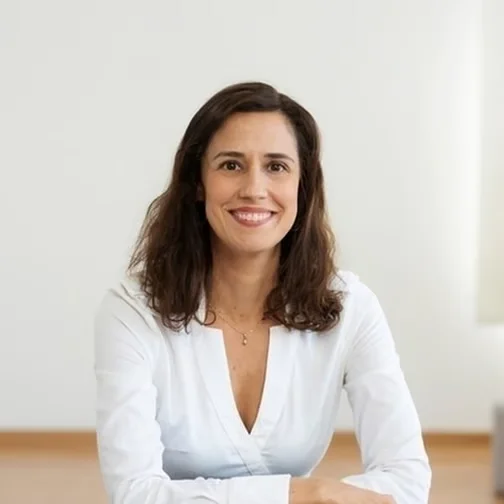
Mentor story
·Midas · 265 sessions
“After twenty years of people helping me, I wanted to give back. The reward is spotting in minutes the thing a founder has sat next to for years.”
Tina Louise
Fractional CMO
Spain · Jun 2026
The Work
Tell us about what you do and how you got here.
I've got, and this shows my age, twenty years of experience in marketing and digital marketing. I started working with web and online before Facebook and Twitter even existed, so it's something much more organic for me than the textbook frameworks. I don't carry the four Ps and the seven Cs around in my head. I've just lived it.
I've had so many great mentors and coaches over the years, and I've learned from so many people, that I really wanted to give back. I don't have my own startup right now, so the way I do that is by helping somebody else's business or entrepreneur or idea. I get to bring as much experience as I have and look at it from the outside, which is often where the difference gets made.
Why Mentor
What made you join GrowthMentor in the first place?
It came from that same place of wanting to give back. After twenty years and all the people who helped me along the way, I wanted to put my experience to use for founders who are looking at their own business from the inside and can't always see what an outsider sees straight away.
The most rewarding part is exactly that outsider angle. I sometimes try not to have any contact with the mentee's business beforehand. So the moment we start talking I'm asking, what is the business about, who is your target, and right away I see things that maybe they haven't spotted in one, two, five, even ten years. Adding that one thing can be such huge value precisely because I'm not inside the business. That's very fulfilling.
Who They Help
People come in fixated on one technical problem. What do you usually find underneath it?
Many times they come with one problem that they think isn't working. It's conversion, it's social media, and so on. But we unlock something much bigger and much deeper that the business actually has to work on. Positioning, usually. I once had a mentee tell me their target was anyone in the manufacturing industry. Well, that's huge. Who is that, who is this anyone? You have to go in there.
Someone will say social media isn't working, so I say let's have a look. What is your messaging, where do people land when they click? Because if that's the issue you can put as much money behind it as you want and it will not convert. It's not that social media is broken, it's your messaging, it's your landing page. The other day someone came in fixated on their CAC and conversion numbers, and I asked, tell me about the customer journey. There were two or three points where people got confused or dropped off. Had they thought about offering PayPal instead of only credit card? That's not a performance problem. It sits before the numbers, and if you fix it you get where you want to go in a much better position.
A Standout Session
Do you follow a methodology in your sessions, or do you wing it each time?
I'm a very big-picture, strategic marketer, so it's not a rigid step-by-step. But there are two or three things that need to be very clear, and first I need to know if they're clear to the founder. What is your value proposition? Who is your target, and what are their pain points? I always love the pain points, because you can have the best product in the world and still get this wrong.
The interesting thing is they always start by talking about their product. I say, I don't care about your product, I care what solutions you have. No one cares about your product. What they care about is their pain points, what they need. So the order is, what problems do you solve and for whom, and the for whom matters enormously, how much do you actually know about your target. Once that's clear we move to channels, conversion, email, increasing whatever needs increasing. And very frequently we don't even get to that second or third point, because the first one was the real work.
Inside the Platform
You said you give one piece of advice over and over. What is it, and how do you make it land?
The key thing I hear over and over is the founder being very proud and only talking about their product. For me the product is just a solution to a problem, so my sentence, the one I repeat, is that no one cares about your product. It's always interesting to watch their face, and then they understand what I mean. It isn't that their product is useless, it's that you have to position it as a solution. They've been so deep in it for so long that no one has ever told them that, and then it clicks.
The example I always give is a headache. If I have a headache and you sell paracetamol, fine, but I could drink water, I could have a massage, I could sleep more, and any of those might solve the same headache. That's the competitive landscape, and it opens their mind. Suddenly they're not selling a pill, they're competing for the outcome the customer actually wants.
What They Got Back
How do you handle a mentee who gets defensive about being challenged?
The interesting thing is I don't gain anything from convincing them. It's different from being in a meeting where I'm marketing and you're comms or product and we're each defending our corner. Here I have nothing to prove. Sometimes a mentee will say, well, this is how we do it and conversion has always been this way, and I'll say, that's great, but have you tried this, what about this?
It's funny when someone reaches out for help and still insists they've been doing the right thing. Okay, then continue. What I'm offering comes from my expertise and years of experience and all the mentees I've worked with, and it might just be a different way of seeing the same thing. So unlike inside an organization, I don't try to prove my point, I try to show different ways for them to understand mine. Most of the time they're not defensive at all, they're curious, taking notes, saying that's different from what we believe but a very good point. And they don't have to implement a single thing I say.
The Filter
You've also used GrowthMentor as a mentee. What did you take from being on the other side?
I have, and honestly I don't use it enough, because it surprised me how good I felt after the session and I kept thinking, why don't I do this more? The hardest part for me, interestingly, is defining what I want out of the session, because sometimes I just want to absorb and talk to those incredible people. But you do need an objective.
One time I had an idea I didn't know how to productize. I teach this, so I knew the pain point and the need in the market and roughly who it was for, but a need isn't a product or a service yet. So I asked two or three mentors how to turn it into something real, and the different approaches were fascinating. One had a clear step-by-step procedure. Another was big-picture brainstorming, put yourself in the target's shoes. Another showed me a tool. They approached the same problem from completely different perspectives, and that's exactly what I tell my own mentees: go talk to other mentors too. One will resonate, another won't, and in marketing there's no single formula that always works. It's experimentation, and the different perspectives are what make it so enriching.
The Verdict
Three adjectives for GrowthMentor.
More mentor stories
View all →“GrowthMentor is exercise for the brain. A session feels like a chore at nine at…”

Barbara Stewart · Customer Experience & Marketing Consultant @ Hiya Marketing
Read Barbara's story“The most rewarding part is helping a founder, then seeing a review about how it…”

Daniel Johnson · GTM & Growth Operator @ We Scale Startups
Read Daniel's storyYour turn
The next story could be yours.
Fewer than 5% of applicants get in. If you've solved these problems, help the next founder.