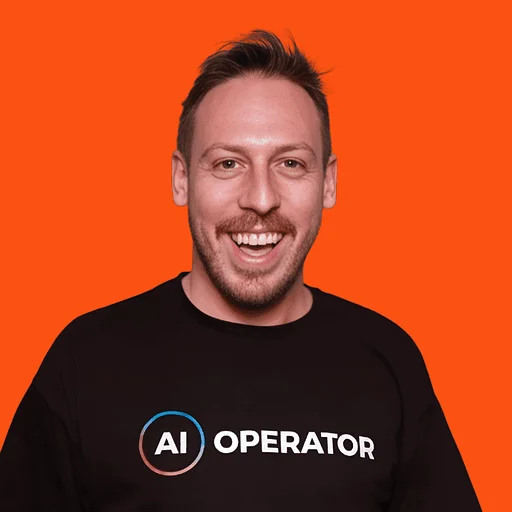
Mentor story
·Nebuchadnezzar · 112 sessions
“The second someone realizes what AI can really do, I see the light bulb go on, their eyes start shining, and it gives me so much hope.”
Tim Cakir
Founder & Chief AI Officer · AI Operator
Spain · aioperator.com ↗ · Jun 2026
View Tim’s profileThe Work
Tell us about what you do and how you got here.
I started in sales, which surprises people. I was selling carpets door to door in California and around the US, back when Skype was just appearing. I was always really into tech, always had the latest laptop, and my friends would laugh because they knew I'd have the latest gadgets. When I moved to London I realized that selling people things they didn't really need wasn't very ethical, and that's when I discovered marketing, then got into growth.
From there I became a growth consultant in Barcelona, mostly for B2B SaaS, but a lot of it was deep tech. I was actually working in computer vision and AI about nine or ten years ago, when AI wasn't cool at all. I loved deep tech, but I'm not a developer and I'm an extroverted person, so I couldn't be the coder sitting at home all day. That was tough for a while.
Then ChatGPT came along. At the time I was the CEO of a 110-person sales outsourcing company, a big role and a good salary, and I left all of it. I quit because I saw the potential in these large language models. It was pretty crap back then, honestly, but I could see where it was going, and I'm glad I jumped. I founded AI Operator about a year ago and it's been one of the fastest growth journeys I've ever been part of. On the side I'm also a sound engineer, music producer, and DJ. That's kind of me.
Why Mentor
What made you join GrowthMentor in the first place?
I've been on the platform for about six years now, going back to my days up in Barcelona, and I think I was one of the early mentors. GrowthMentor is actually where I learned that growth wasn't just hacking. Growth hacking was the cool thing at the time, and through the platform I discovered there was such a thing as sustainable growth, and a lot of really interesting work to do in the field. So it shaped how I think.
These days I keep showing up because I genuinely love it. Earlier on I think I was doing it partly because my own work was more painful, and giving back was a release. Now I do it because I absolutely love the topic. The more I speak to people, the more I understand their problems, and that helps me as much as it helps them. I meet incredible people on the platform, and when someone realizes the power of this technology and their whole outlook shifts, that's the part I keep coming back for.
Who They Help
You talk a lot about an AI-first mindset. What does that actually mean in practice?
I call it a mindset on purpose, because it's a complete change, and I honestly think it's a bigger change than electricity. Think about London a long time ago, where people would walk the streets at night and light the torches so we could see. That job disappeared, and we learned new ones: electrical engineering, all of that. It's the same shift now. We have to relearn how we work.
So it's not just here's ChatGPT, here's prompt engineering, off you go. It's asking yourself, every time you do a process, how can I do this with AI? How do I find a document to feed it? How do I speak to these machines? Prompt engineering matters, context engineering is becoming even bigger, and there's so much that goes around it.
That's why when we train people, we train the mindset first and get into the tools after. The tools will keep changing, you'll always get a new one, but the mindset is the thing that lasts. And the goal is that people stop fearing this technology and start to love it, because once you love it, you use it for the benefit of the people around you instead of bracing against it.
A Standout Session
A lot of people are scared of outsourcing their own thinking to AI. What's your take?
There are two ways to use this technology. There's the lazy way, which is go do this for me, and then you take the output and just run with it. And there's the intelligent way, where you say, hey, I'm going to do this, ask me ten questions on how we're going to achieve it together. It starts asking, and you're sitting there going, my God, I never thought about that.
Honestly, I don't think I've ever worked my brain this hard. These tools ask me incredible questions, and I don't have that tunnel vision anymore. We're humans, we have real strengths, but our brains aren't built to store endless information, they're built to solve problems. The large language models hold the massive data sets, and we get to tap into them whenever we need.
The news loves to run human versus AI, the math competition, kids getting dumber in school. And yes, if a kid just says do this for me, done, they're not learning. But why is there never a benchmark of human and AI doing things together? That's where the magic is, the human plus the AI, and that's exactly where we're betting as a company.
Inside the Platform
A business has some traction and wants to get started with AI. What's the first thing they need to get right?
The mistake I see most often is a leader playing with ChatGPT over the weekend, getting excited, and then giving the whole team a login and saying, here you go, be super productive. Then they come to us, we run a survey, and we find only 20 or 30 percent of the team actually uses it properly. They're shocked. They paid for the teams plan, so why isn't everyone flying? Because this isn't HubSpot, it's not just another CRM. It's a completely different way of working.
So you can't just hand out access. You need a bit of training, some change management, often a third party to come in and help. And the way we approach it is to make everyone an AI champion, not to appoint one chief evangelist. We want every team member to stop fearing it, to see where they're saving time today and where they could save it tomorrow, so they all help each other and discover new things together.
The principle underneath all of it comes from something Dharmesh at HubSpot said that really stuck with me: try everything with AI first. Every task, every project, every question, attempt it with AI. If it fails, fine, you learn why it failed and what the tool is good and bad at. While you're waiting for perfection, other people are already running with it.
What They Got Back
What's an automation win that genuinely surprised the person it was built for?
My favorite example is a field salesperson who, in our survey, wrote that AI couldn't help him because he'd been doing his job for twenty years. I saw that and thought, challenge accepted. This guy was going store to store at retail shops, and every Friday he'd lose half a day to writing up reports. So we got him excited enough that he built a custom GPT himself, one that wrote SQL queries and pushed and pulled information from Salesforce.
Now, the second he leaves a store, he turns it on, puts his AirPods in or runs it through CarPlay while driving between shops in rural areas, and just talks. It asks him the reporting questions, stores everything in the CRM, and it feels natural, like talking to an assistant. His reporting is done before he gets to the next town, so on Fridays he can do even more visits instead of paperwork. His twenty years of experience is exactly what we need, the AI just carries the boring part.
I do the same thing for myself. I used to spend a couple of hours a day staying on top of fifteen to twenty newsletters. Now an automation reads them and produces a custom nine-minute podcast that lands in our Slack at nine every morning, and I listen to it on the drive back from dropping my daughter at school. The way I frame it for people is the eighty-twenty: AI does eighty percent of the work, and the human does the twenty percent that actually matters. You're still the tastemaker, still the approver.
The Filter
You've spent sleepless nights inside tools like Replit and Lovable. Are they toys, or can you build something real?
I fell in love with all of these tools and lost a lot of sleep trying every one of them. On their own, they're not powerful enough yet for incredibly stable, high-stakes products. But they're fantastic for low-stake internal tools. Why buy a giant CRM and use twenty percent of its features when you can take a weekend and build your own, custom to exactly how you work? If it breaks, it's not the end of the world, it's an internal tool. I've built a client portal, a training portal, an AI ROI calculator, an AI readiness assessment. Great lead magnets, and low risk.
Where it gets really good is the combination. The lesson isn't the right tool, it's the right set of tools. I'm not a developer, so I'll start a project in Replit because it sets up the folders, the backend, the frontend, and the auth, all the structure I'd struggle with otherwise. Then, inside its terminal, I run Claude Code, which is the best thing I've seen for refactoring, breaking pages down, and cleaning up the code. Replit and Lovable can't do that part, and Claude Code can't do the scaffolding part as easily, so together they're unstoppable.
The deeper shift is that building isn't the hard part anymore. What matters now is creativity and the ability to articulate your vision so the model can understand it. I had an idea over a weekend for a habit app for my four-year-old daughter, posters of unicorns and whatever she likes, running on a tablet on the fridge so she builds good habits. I built the whole thing and called it Routine Magic. Two years ago I'd never have touched an idea like that.
The Verdict
Three adjectives for GrowthMentor.
More mentor stories
View all →“GrowthMentor is exercise for the brain. A session feels like a chore at nine at…”

Barbara Stewart · Customer Experience & Marketing Consultant @ Hiya Marketing
Read Barbara's story“The most rewarding part is helping a founder, then seeing a review about how it…”

Daniel Johnson · GTM & Growth Operator @ We Scale Startups
Read Daniel's storyYour turn
The next story could be yours.
Fewer than 5% of applicants get in. If you've solved these problems, help the next founder.