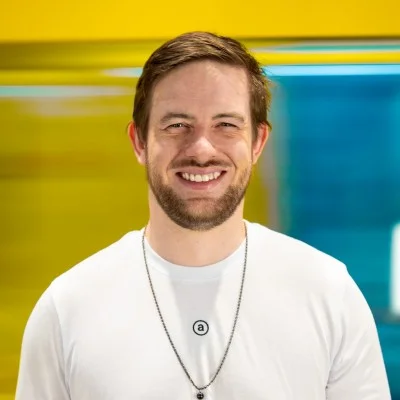
Mentor story
·Nebuchadnezzar · 104 sessions
“The quality of your life is the quality of your questions. Most of mentorship isn't telling people what to do, it's asking the right one.”
The Work
Tell us about what you do and how you got here.
I'm a growth marketer with a long background in blockchain, which is a slightly unusual combination. I got into Bitcoin back in 2012 when there was really only Bitcoin and Litecoin around. I was studying my master's in mechanical engineering at the time, and a friend invited me to a hackathon in Berlin where I met someone who told me to check out this digital money thing that was going to change how we think about money. It sat with me, and when I got back to university I used some of the high-powered design machines there to mine a few Bitcoin, worth about five dollars each back then.
At graduation I hit a fork in the road: do I go down the engineering path, or chase this. I realized what I actually wanted to do was grow businesses, work with senior people and turn projects into real companies, and that's how I ended up at Ladder, the growth agency Mike Taylor built. While I was interviewing with Mike I was also interviewing for engineering jobs, and the rest is history. Since then I've worked with crypto exchanges, helped build the blockchain discipline at Ladder, worked on NFT projects, and was marketing director at Salad. So I've seen a big spectrum of what Web3 actually is, paired with the conversion-focused marketing fundamentals the agency world drilled into me.
Why Mentor
What made you join GrowthMentor in the first place?
I've pretty much always been a mentor, and of course always a mentee too. I genuinely believe life is a learning journey, and anytime you can capitalize on the mentors here, it's awesome. My GrowthMentor journey really started after working for Mike Taylor at Ladder. There are quite a few ex-Ladder people on the platform, and after watching colleagues and Mike join, I reached out and had a chat.
My skill set at the time was fairly unique. Back around 2017, 2018, 2019, I was kind of the blockchain guy, and I'm also a growth marketer, so it was a really good fit and a unique category for growth. Whenever a request came in for a blockchain startup, the platform could just say, go speak to Morgan, and I became that person. The pull is simple: I get to hear a lot of different problems from a lot of different founders, which is the agency experience I don't get anymore now that I'm inside a single business. That variety is exciting and energizing, and it's why I keep showing up.
Who They Help
What's the mindset you bring to every session?
I think the thing that's benefited me most over my career is a very conversion-based mindset. A lot of people get confused about why we do marketing in the first place, so they start chasing vanity metrics, feel like they're making progress, and then three months later they're scratching their head wondering why more followers didn't turn into more money. I credit Ladder and Mike Taylor for beating this out of me. Working across a huge range of clients teaches you to walk into any business and find the fundamentals fast.
So a lot of the value I give as a mentor is asking, what's the ultimate conversion goal here, what's the crux of the problem we're actually trying to solve, and then working back from where you make money into the details. Is your landing page converting? Are you actually speaking to your customer, or writing in a way that makes you feel good because you think you're explaining your business, when the reader is going, I don't get it, I don't know what value you bring to my life? They're small changes, but once a founder has that shift, you can make a tweak, see some results, and iterate from there.
There's also a mental model I use on my own problems. When you're in the middle of something it becomes personal, you're attached, and it's hard to zoom out. So I ask myself, if I were mentoring this person with this problem, what would I tell them? That detaches you, the perspective shifts, the simple changes become obvious, and a lot of the anxiety just dissipates.
A Standout Session
Founders often resist the idea of testing. How do you handle that?
I'd go further and say business itself is a testing game, because ultimately you're operating in uncertainty. There's a quote about building a business being like staring into the abyss and chewing glass, and it's kind of true. You have a vision of what you want to do, but a vision isn't a strategy, it's just a desired outcome. At any point your customers can turn around and tell you, actually this isn't the problem you're solving in my life, this other thing is. So an experimental mindset lets you run small-scope tests, a landing page, a feature, a community, and stay detached enough to actually listen to what comes back.
The caveat, which a close ex-Ladder friend of mine, John Ostrowski, puts perfectly, is that we're not running a laboratory here, we're running a business. You can be data-led and experimental without being so attached to the data that it causes analysis paralysis, where you won't act because the numbers aren't giving you absolute certainty. No amount of data or feedback is ever going to be a hundred percent perfect. There's always uncertainty, so your job is to operate with the best knowledge you have at that point in time, then iterate and keep going. Sometimes you just have to take the first step.
Inside the Platform
Web3 carries a trust problem. Where do you think it's actually heading?
The trust issue with crypto is real, and it's different from other industries because there's always a financial incentive in the mix. Every new technology gets its cowboys, the same way the dot-com bubble had people buying domains and claiming they were worth millions, but with crypto you have retail investors, ordinary people who can't afford to lose the money and rightly get upset when they're misled. So I understand the skepticism. But a lot of the genuine value comes down to self-sovereignty: if you hold your own wallet, no one can shut it down or take your coins away, for as long as the internet exists.
Where I get really excited is identity, which is where I see Web3 turning into the next wave. Take a simple example I use: I like whiskey, and a shop needs to know I'm of legal age, but they don't actually need to store my date of birth in a form somewhere forever. With a zero-knowledge proof, an algorithm can ask my wallet whether I'm over the age limit, my wallet says yes, and the shop trusts that without ever knowing or keeping my data. For a marketer that's huge, because identity is owned and permissioned by you and you alone. The same idea lets someone in one country prove their degree and work history anywhere in the world, trustlessly, without anyone having to call up a university to verify it. We're right at the cusp of what this can do, and that future is genuinely exciting.
What They Got Back
What's your playbook for a great mentor session?
I have a mantra written on the wall over here: the quality of your life is the quality of your questions. I truly believe most of mentorship is not telling people what to do. There's a real difference between mentorship and coaching. A coach has a long personal relationship with you, observes you, and gives brutal honest feedback over time. A mentor, especially here, often has just one or two sessions with someone who arrives with a specific problem and wants a different perspective on it. You don't have their metrics or a long feedback loop, so I always hesitate to give direct advice. Your role is to ask questions and listen, pick up on the small nuances, the moment their expression changes, the place where they don't yet see where the real pain lies. People too close to a problem usually think it's everything, when really it's one thing.
So my advice to new mentors is to get familiar with questions. I collect them, a habit I picked up from being a big Tim Ferriss fan. If I read an interview and there's one great question that cuts to the core and makes someone stop and go, oh yeah, now I see it, I keep it. I also ask mentees for as much context as possible up front, the business model, how they make money, the ultimate conversion goal, why the business exists, so I come prepared instead of wasting the call on basics. A book I'd recommend every mentor read is Nonviolent Communication. It teaches you to hear the need and the pain behind what someone says, not just the words, and to mirror it back so you both reach understanding before moving on. I always end a call by getting the mentee to mirror back what they're taking away and what they'll do next, and I invite them to follow up, because it shouldn't be a single interaction.
The Filter
You once got hired off a single call here. What happened?
It's one of my favorite stories, and I still have the screenshots. The founder of Salad came onto the platform wanting to grow his business. Salad lets young people outsource their high-powered GPUs and gaming rigs when they're away from their computer, and in return they get gift cards and rewards rather than money, which is a very attractive model for someone who needs their parents' permission to buy things. A blockchain request came in, the platform pointed him to me, and we had one hour-long call.
In that single interaction I apparently made enough of an impression that he sent me a LinkedIn message afterwards saying he wasn't going to beat around the bush, he wanted to hire me, was I available. That was it. I became marketing director of that company, and the rest is history. It was a real step up, from a head-of role to a director, and a genuinely exciting business to be part of, especially with where decentralized compute is going now that AI needs so much of it. GrowthMentor has given me amazing opportunities personally, and that one came out of nowhere from a conversation I went into purely to help. The lesson I took is simple: always leave a good impression.
The Verdict
Three adjectives for GrowthMentor.
More mentor stories
View all →“GrowthMentor is exercise for the brain. A session feels like a chore at nine at…”
Barbara Stewart · Customer Experience & Marketing Consultant @ Hiya Marketing
Read Barbara's story“The most rewarding part is helping a founder, then seeing a review about how it…”

Daniel Johnson · GTM & Growth Operator @ We Scale Startups
Read Daniel's storyYour turn
The next story could be yours.
Fewer than 5% of applicants get in. If you've solved these problems, help the next founder.