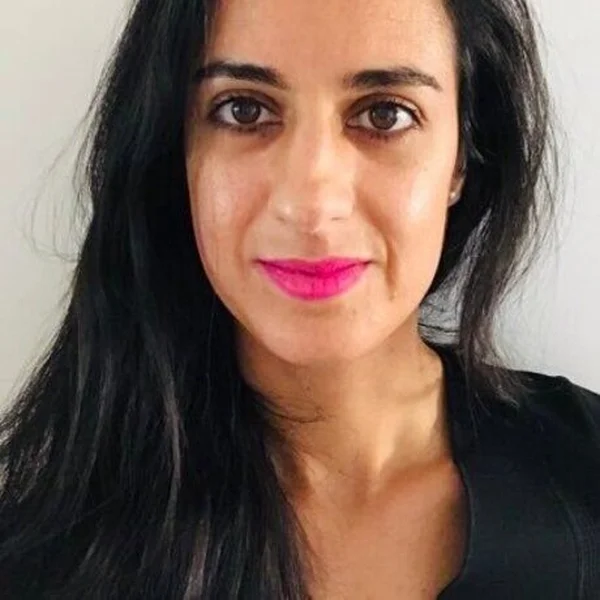
Mentor story
·Balthazar · 40 sessions
“I came Googling 'find a mentor, please.' What I found wasn't one mentor, it was mentors plural, a little board of advisors I'd never have built on my own.”
The Work
Tell us about what you do and how you got here.
I'm a marketer by trade, that's been my world for about ten years now, and these days I work as a fractional CMO out of Barcelona. Last October I left a very cushy in-house job at a Series B and went out on my own, mostly because I'm a working mother of two and I needed the flexibility. Right now I'm working with HR tech and ed tech companies, pre-revenue, small budgets, still in the ideas and validation stage.
What I love about the fractional route is that you don't drink the Kool-Aid of one single business. In-house you essentially become the product, flexing the same muscles over and over. Going fractional means I get to deal with different verticals, different problems, companies at different stages. I call it my Lego career: I can build it up and build it down. It brings a lot of uncertainty, I won't glamorize it, but the flexibility is worth it.
Why Mentor
What made you join GrowthMentor in the first place?
I came in as a mentee, not a mentor. It was 2020, I was one of the millions stuck in their houses, and I'll be super honest: there were no promotion opportunities anywhere in sight. My peers told me flat out, nobody gets a raise here, what you walk in with is what you walk out with. I've got a double masters, I'm an insatiable learner, and I felt this crushing sense of being stuck, physically in the apartment and stuck in my career.
The problem was I'd never built a network. I'd been the in-house employee who clocked in at ten and left at six, weekends were for parks and recreation, so I'd unwittingly fenced myself in. I kept journaling, who could my mentor be, Jane, Jessica, John, and every time the answer was, I like them, but no. So eventually I Googled something like "find a mentor, please," and GrowthMentor was one of the first organic results. It had the cleanest brand, it felt like a friendly, welcoming website, so I thought, let's just try this. It completely worked.
Who They Help
You started as a mentee and flipped to mentoring almost straight away. What triggered that?
It was pretty instantaneous, honestly. The thing that did it was my interns. At work I'd been handed a couple of graduates, and I remembered being an intern myself years earlier, opening mail and getting Starbucks and feeling like it was such low-caliber work, learning nothing about the business. So when I had my feet in the other pair of shoes I said, let's get these guys doing the real thing: social listening, building reports, crafting copy. Whose job am I protecting here? Watching them turn out capable and grateful made me realize there was something in me that wanted to help others. And then it dawned on me: I've been in this field six years, why not put it out there that anyone with a question, anyone who wants an introduction to my network, go for it.
Because I've honestly never feared sharing knowledge. I might worry about losing my job to a market correction or internal politics, but never because someone learned what I know. I've met so many people who won't let you in too far in case you're ready to take over, and that scarcity mindset is just a sad, low way to live.
And sharing has been a genuine game changer for building community. Through GrowthMentor I'm suddenly doing meetups with other mentors in my city, and one of them says, hey, I know someone hiring for the role you want, and you do the same back for them. Like attracts like. When you give a lot, the people who gravitate toward you are the ones who give back, so your cup is never half empty.
A Standout Session
You're known for building communities around early-stage products. How does that actually work?
I learn it on the job, like most things. Take the ed tech client. I'm a parent, I know other parents, my kids are at school, so when I needed scale to test a new app I had two options. Do it painfully, convincing friend A then friend B one at a time, wasting everyone's time. Or go to the school where I'd built a strong relationship with the principal and say, you know me, you know my kids, you know my work, let me run a session with the parents association.
So we set up a day where kids come to a spare classroom after school with their parents and just test the game. No extra work for the teachers, they've got a stack of iPads in the cupboard, it's scrappy but it works. You get real scale without knocking on a hundred doors, and it only works because there's a trusting, generous community already around you. It's a focus group without paying an agency ten thousand euros to set it up. I don't lean on Slack groups much, I lean on getting a whole bunch of the right people in the same place at the same time without too much effort.
Inside the Platform
You talk a lot about playbooks that don't work. Why is that the part you emphasize?
Because LinkedIn is awash with playbooks for this and playbooks for that as free lead magnets, and you think, wow, these people must know what they're doing because they made a PDF and lured me in. But a lot of playbooks are really just trying, testing, and failing. No playbook is rock solid, none of them is a timeless manual for succeeding at the exact thing you're trying to do.
The clients I work with have tenuous budgets, so naturally they want a hundred percent success rate, they do not want to lose money or fail. But the founder who accepts that failure comes before success, who fails fast and fails lean, is the one who gets where they need to go. The ideas stage is honestly the riskiest moment, because for most founders it's their hard-earned savings, not angel money. So tolerance for risk has become one of my main filters on discovery calls. My job is to answer as many of their open questions as I can, and that takes an investment in time and a bit of money, but it's the only honest way through the ambiguity.
What They Got Back
What's changed in you because of all this?
It put me on both sides of the table, and that changed how I see my own work. As a mentee it pulled me out of the corner I'd fenced myself into. As a mentor it reminded me what I actually love. When I left my full-time job I tried all sorts of things with nothing to do with tech, I started a little company making Middle Eastern cakes and shipping them to cafes around Barcelona, I trained as a certified yoga instructor. I enjoyed all of it. But none of it gave me the dopamine I get from a brand campaign that works, watching the cost per lead drop and going, wow, I did that. The need to build keeps dragging me back.
The deeper change is about the network. In today's job market a great network is ten times more important than it was a few years ago, and I genuinely wasn't alone in feeling fenced in. GrowthMentor accelerated that for me. It's not finding a mentor, it's finding mentors plural, an entourage, a little virtual board of advisors. That's the thing I keep flying the flag for.
The Filter
Who makes a good mentee or mentor here, and who doesn't?
On the mentor side, this only works if you're genuinely a giver. I've always tended to give, give, give, and if you give without ever getting it back, you do get drained, that's something to be mindful of. But in a community like this the mentors and even the mentees are giving people, so you make a lot and you receive a lot back. If you show up that way to a bunch of people who operate the same way, you never get shortchanged.
The trap I'd warn mentors about is being so giving you become overwhelming. I'll rattle off ten ideas at someone and you can see them topple over. So read the person in front of you. And for mentees, the best use of the platform isn't rocking up to say I don't know what to do with my life, can we talk general directions. It's coming in with the actual work, sharing your screen, and getting an expert to tweak it, make the corrections, and spot the blind spots in half an hour. Come with the thing, not just the question.
The Verdict
Three adjectives for GrowthMentor.
More mentor stories
View all →“GrowthMentor is exercise for the brain. A session feels like a chore at nine at…”
Barbara Stewart · Customer Experience & Marketing Consultant @ Hiya Marketing
Read Barbara's story“The most rewarding part is helping a founder, then seeing a review about how it…”

Daniel Johnson · GTM & Growth Operator @ We Scale Startups
Read Daniel's storyYour turn
The next story could be yours.
Fewer than 5% of applicants get in. If you've solved these problems, help the next founder.