TL;DR
- The chicken and egg problem: a marketplace needs supply to attract demand and demand to attract supply, and on day one it has neither.
- There is no growth hack that spins up both sides at once. Every marketplace that worked built one side by hand first, ugly and unscalable, until the other side had a reason to show up.
- The playbook: pick the harder side and build it by hand, go absurdly narrow (one city, one niche), make that side useful before the other arrives, and do things that do not scale until the loop turns on its own.
- GrowthMentor's own cold start in 2018 ran the same way. I hand-recruited the supply, reaching out to people I admired one message at a time and inviting them to mentor. The give-first and membership model that actually worked, I only found by onboarding the first few hundred members myself and talking to every one of them.
Every marketplace founder hits the same wall in the first month. To get sellers you need buyers, and to get buyers you need sellers, and you are sitting there with neither. Sellers will not list on an empty platform. Buyers will not visit one with nothing to buy. The two sides each wait for the other, and nothing moves. That standoff is the chicken and egg problem, and it has killed more marketplaces than any competitor ever has.
I have been on the wrong side of it. In 2018 I started GrowthMentor with no mentors and no mentees, the marketplace version of an empty restaurant on opening night, and I ran it as a classic commission marketplace. No clever loop filled it. I filled the supply side the slow way, by making a list of people I admired and reaching out one message at a time, asking them to come mentor. Some of those messages were pure research, people who used platforms like Clarity.fm, asking what was broken so I would know what to build.
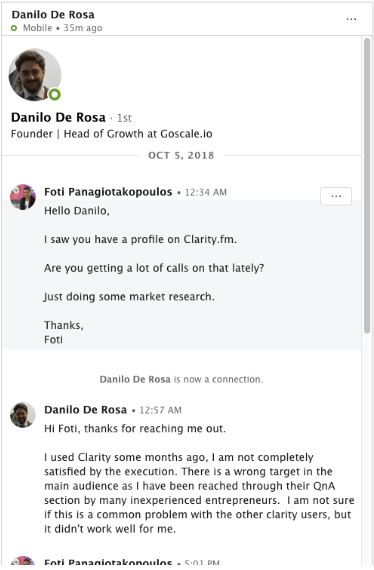
There was no growth hack. There was a list of people I admired and a lot of messages.
The trick everyone wants does not exist
Founders come to this problem looking for the one move that fills both sides at once, a referral loop, a launch tactic, a clever incentive. I looked for it too.
It is not there.
Look closely at any marketplace that made it and you find the same unglamorous thing at the start. The founders built one side themselves, by hand, and ate the cost until the other side had a reason to care.
How the ones that made it built a side
Went door to door in New York, recruiting hosts and fixing their listings by hand.
Seeded the early site with fake accounts so it never looked empty.
Guaranteed drivers a minimum wage so cars stayed on the road before the riders came.
GrowthMentor
Hand-recruited the first mentors, one message at a time, to people I admired.
None of it scaled. All of it worked, because each one bought the thing an empty marketplace cannot make on its own, a reason to be there.
The four moves that work
- Pick one side and build it by hand. Decide which side is harder to attract, then make it real yourself. Airbnb recruited the hosts in person. Uber guaranteed the drivers a wage. I reached out to the mentors I wanted, one message at a time.
- Go embarrassingly narrow. Do not launch a marketplace for everyone everywhere. Launch it for one city, one niche, one use case, small enough that a handful of participants on each side already feels like a full market. Airbnb started in a few neighborhoods. I started with growth marketers, not all of business.
- Make one side useful before the other shows up. The side you have should get value even alone. A mentor profile is a small portfolio whether or not a call ever gets booked. Solve that single-player problem and you are not betting everything on the loop closing on schedule.
- Do things that do not scale, on purpose. Hand-recruit the first hundred. Onboard them yourself. Send the emails personally. I read every early application by hand, and still read every mentor application today. The manual phase is not a failure of the model. For a while, it is the model.





Stuck on the cold start of a two-sided thing?
Book a 1:1 with a founder who has built a side from nothing. One membership, unlimited calls, every mentor included.
The unglamorous version, told straight
Here is GrowthMentor's cold start without the gloss. Once the first mentors were on and the product was live, the signups came, about a quarter of the people who landed left their email. Then the real problem showed up. They joined and did nothing. An inbox full of email addresses I knew nothing else about, and a platform full of accounts that never moved.
A marketplace full of people who would not show up to it.
So I did the unscalable thing on purpose. I put a survey in the way, which cut signups by most of their volume and raised their quality, and from October to December 2018 I onboarded 328 of them by hand, one at a time, writing back to each person about the thing they were stuck on.
That hand work is where the real business came from. Talking to all of them taught me what no dashboard could. The commission marketplace I started with was the wrong shape. The mentors wanted to give a first call for free more than they wanted to set a price, so we let them, and give-first became the model. And what people would pay for turned out to be a membership, not a cut of every booking.
You do not find the model in a spreadsheet. You find it in the two hundredth conversation.
It was slow, and there was no single day the thing switched on. The give-first habit those first mentors set became the culture, and the culture became the filter. Today GrowthMentor turns away more than ninety-five percent of mentor applicants, and what keeps the bar that high is the same thing that solved the cold start, people who show up to help before there is anything obvious in it for them.
Built from zero
The cold start is a founder problem, and reading about Airbnb does not tell you which side to build first or how long to carry it. These three have built and validated companies from nothing, and they will talk through your specific standoff on a call.



Which side do you build first?
The usual answer is supply, and usually it is right. The side you build first is the one that creates the value the other side comes for. On GrowthMentor that is mentors. On a hiring marketplace it is candidates. On a delivery app it is restaurants. Build the side that is hard to fake convincingly, because the side that just consumes value is easy to bring in once there is something worth consuming. Then you win that side the same way every time, by giving it far more value than you charge for, until the holy-shit-this-is-for-me is impossible to miss. If you are not sure which side is which for your idea, that is worth one mentor call before it is worth six months of building the wrong one.
Frequently asked questions


Founders who built a side from nothing
There is no growth hack for the cold start.
There is someone who has already survived it.
You can read every Airbnb story online. None of them tell you which side to build first, or how long to carry it. Talk to a founder who has, and keep them for the next decision.
Talk to a mentorKeep reading
More from the GrowthMentor blog
Mentorship · Feb 18, 2026
The best founder communities in 2026. And the one room none of them can be.
Foti Panagiotakopoulos
Growth Strategy · Apr 20, 2026
AI does the work now. It still can't tell you which work is worth doing.
Foti Panagiotakopoulos
Mentorship · Feb 07, 2024
How to Find a Mentor For Your Startup (Message Templates Included)
Micah McGuire