How to Be a Good Mentee (What the Best Ones Do)

Most guides on being a good mentee optimize the hour with your mentor. The ones who get somewhere optimize the six days after. Here's what that looks like.

PublishedMay 2020 · 7 min read
AuthorFoti PanagiotakopoulosFoti Panagiotakopoulos · Founder of GrowthMentor

A good mentee comes prepared, tells the truth, respects the clock, and acts on what they hear. That's the short version of how to be a good mentee, and it's roughly what every guide will tell you. The longer version is the one worth reading, because what makes a good mentee great has less to do with the call itself than with what happens in the days after it.

TL;DR

  • Good mentees act between calls. Smart questions are nice. Follow-through is the whole game.
  • They come for permission as much as advice, and they say so out loud.
  • They prep the boring adjacent stuff (their numbers, their constraints, what they already tried), not just their pet topic.
  • They say "I don't know this" without flinching. It's the fastest way to point a session at what they really need.
  • They design the relationship, then close the loop: do the thing, report back, repeat.

Here is the part nobody tells you. The hour with your mentor was never the bottleneck. The six days between calls are. You can ask the sharpest question in the world, nod at a brilliant answer, and change nothing. The mentees who get somewhere treat the call as the start of the work, not the work itself.

There is a line I think about a lot.

"The only shortcut is hard work."

Wes Bush

Your mentor is not a magician. Real breakthroughs on a single call happen, but they are rare. The value of the session tracks almost exactly with the effort you put in afterward to execute what you discussed. Go in expecting a shortcut and you will be disappointed. Go in expecting a sharp second opinion that you then act on, and you will get your money's worth ten times over.

What separates a good mentee from a mediocre one

Here is the uncomfortable part. The most common kind of mediocre mentee is not lazy or rude. They are self-aware. They can describe their problem in perfect detail, diagnose exactly why they are stuck, and then do nothing about it for three months, until the next call, where they describe it again. Diagnosing yourself is cheap, and most people are good at it. Acting on the diagnosis is the rare part, and it is the only part that counts.

A good mentee

  • Acts within days, not months
  • Names what they're avoiding
  • Brings one specific stuck decision
  • Asks for the story behind the answer
  • Reports back what happened

A stuck mentee

  • Diagnoses endlessly, acts rarely
  • Over-prepares to delay starting
  • Waits for one magic answer
  • Keeps the ask vague to stay flexible
  • Disappears until the next call

Before the call: prepare the boring stuff

Most people prepare for a mentor call the way they study for the part of the exam they already know. They polish the topic they are comfortable with and skip the adjacent stuff the mentor will ask about first. If you are there to talk about your launch, the mentor will want your numbers, your audience, and what you have already tried. Have those ready. The fastest way to waste a session is to spend the first fifteen minutes establishing context you could have sent in advance. If you want the full method, we wrote a whole guide on writing a session request.

Your goal
What you want to walk out of the call able to do.
Your constraints
Budget, time, team size, anything that rules options out.
What you've tried
The things you've already attempted, and what happened.
The one decision
The single call you're stuck on, stated as a question.

Send that before the call so your mentor is not staring at a blank page when they join. One caveat, and I mean this: do not send a novella. Nobody wants to read three pages before a thirty-minute call. Keep it under 200 words. If you cannot get it under 200 words, you have not found the real question yet.

To:Your mentor
Subject:

Context before our call Thursday

Hi [name],

Quick context so we can skip the setup. I run [what you do]. Goal for the call: [the one thing you want to leave able to do].

Where I'm stuck: [the specific decision], stated as a question. I've already tried [X] and [Y], and here's what happened.

Constraints: [budget / time / team]. I'll send nothing else, promise. See you Thursday.

During the call: say "I don't know this" out loud

The single most useful sentence you can say in a mentor session is "I don't know this." It feels like admitting weakness. It does the opposite. The moment you say it, the mentor stops guessing what you do and do not understand and points the conversation straight at the gap. Treat the call like a session with a therapist: the value is capped by your honesty. Hide the embarrassing number or soften the real situation, and the advice you get back will be tuned to a problem you do not have.

There is another reason people book calls, and it is worth naming. A lot of the time you do not need a new idea. You already know what to do. You need someone who has done it to look you in the eye and say "yes, that's right, go." That is not a waste of a session. Permission from someone credible is one of the most valuable things a mentor gives, especially when you are a founder making a call nobody around you can validate. The good mentee knows the difference between needing advice and needing permission, and asks for the one they actually came for.

The gap closes faster when you book often, not once

A single call is a second opinion. A mentor on standby is how you keep closing the loop, week after week. One membership, unlimited calls, every mentor included.

Find a mentor

Ask for stories, and push back

When the conversation opens up, push it toward stories. Advice tells you what to do. A story tells you why, and what it felt like when it went sideways, which is the part you cannot get from a blog post. Ask your mentor to tell you about a time they faced the same wall. Then ask them to argue against you. A mentor who only nods is doing half the job, and a good one will happily play devil's advocate if you invite it. If you want to know why the best mentors talk less than you would expect, we got into that in a separate piece.

  • "Tell me about a time you faced this. What did you do?"
  • "What would you do in my exact position, and why?"
  • "What am I not seeing here?"
  • "If you had to bet, which of these is the real problem?"
  • "What would make you walk away from this?"

What your mentor is doing on the other side

Once you have had a few sessions, you start to notice the moves. A good mentor runs a call on a small set of them, and almost all of them are compression. They interrogate before they advise, because advice on a blurry picture is worthless. They go silent early and let you frame the problem first, so they can watch how you think. They cut you off mid-sentence to fix a structural error live. They relabel your stated problem as the real one. They get blunt, because softening wastes the hour. And they close with named homework, not a goodbye. Once you can see the moves, you stop fighting them and start feeding them.

They go silent and let you talk first
The silence is a test of how you frame your own problem, not politeness. Use it for a tight, structured overview, not a ramble.
They relabel your problem
When they say "the real issue is X," run toward the new frame instead of defending your old one. That's the highest-value moment in the call.
They cut you off mid-sentence
Being interrupted is a gift. Stop, take the correction, and build on it. Talking over it to finish your point is the costly reflex.
They get blunt
A flat verdict like "your messaging is broken" is the thing you came for. Don't argue it down. Write it down.
They open your real screen
The best sessions happen inside your live ad account or funnel, not your description of it. Show up with the thing open and ready to share.
They close with homework
The value is in what you do next. Capture the action items word for word, and do them before you book again.

Here is the pattern under all of it. A good mentee shows up already compressed. Numbers ready. Screen open. One priority picked. Their framing held loosely, in case the mentor relabels it. Do that, and the mentor spends the whole call on the insight you came for instead of the cleanup.

After the call: the part that counts

This is where good mentees are made, and it has nothing to do with the call. Within 48 hours, do one thing the mentor suggested. Not all of it. One thing, while it is warm. Then write down what changed. If you are talking to more than one mentor, this is also where you start forming patterns: when three sharp people independently tell you the same uncomfortable thing, stop debating it and listen.

The 48-hour loop

1.

Do one thing

Within two days, act on a single piece of advice while it's fresh. One, not ten.

2.

Note what changed

Write down what happened when you did it. This is the data your next session runs on.

3.

Close the loop

Tell your mentor what you tried and what came of it. Mentors remember the mentee who reports back.

4.

Leave a review

If you booked through a platform, leave the review while the call is fresh. It's the cheapest way to thank someone who helped you.

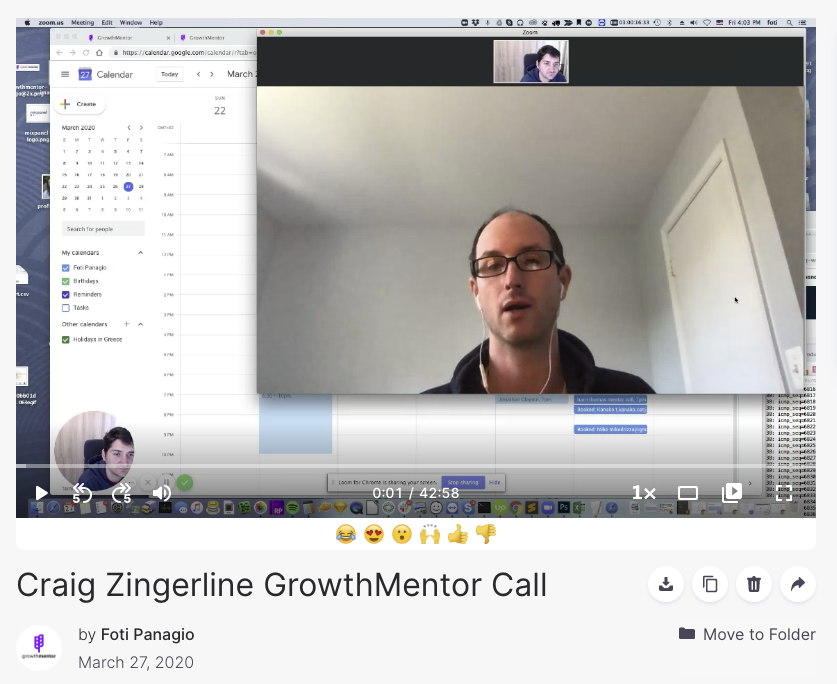
One mechanical tip earns its place here: record the call, but only if you will really rewatch it. With your mentor's okay, record the screen. My tool for this is Loom, and I run the recording through Descript to get a clean transcript I can mine later. A recording you never open is theater. And while you are closing the loop, a short thank-you note goes a long way.

A recorded GrowthMentor call open in Loom
Recording a call in Loom so you can revisit it later, instead of trusting your memory.

Design the mentorship

Once you have had a few calls, you can get more sophisticated about it. The best mentees I have watched treat their mentorship like a system they are designing. They separate strategy calls from execution calls instead of cramming both into thirty minutes. Some of them deliberately withhold their own analysis at the start, so the mentor reads the raw data and reaches a conclusion before getting anchored by yours. And they do not lean on one person for everything. They find a few mentors with different strengths and triangulate.

Part of being a good mentee is matching the question to the right head. Do not ask a brand strategist to debug your paid funnel. If your problem is channel-specific, go find the person who lives in that channel, whether that is a marketing specialist or an operator who has shipped the exact thing you are staring at.

Common questions about being a good mentee

Mentors who've sat on both sides of the call

You know how to show up now,
go bring it to a real call.

Send the context, ask for the story, get pushed on the plan you walked in with. One honest 1:1 is where the prep turns into a decision you can act on this week.

Talk to a mentor
750+

Stop reading.
Start talking.

An article gives you the general answer. A mentor gives you yours. Skip ahead — book the call.

Find your mentor

Unlimited sessions · cancel anytime

7 min left